
Every autumn the Care Quality Commission sends Parliament its verdict on health and adult social care in England. This year's State of Care report came out on 23 October, and much of what it says about adult social care comes back to one question: are the right people, with the right skills, on shift?
What CQC found
The headline on quality is mostly positive. Of the 3,783 care homes rated under CQC's current framework, 70% are good or outstanding. Around 9 in 10 are rated good or outstanding for being caring and responsive.
Leadership is the weak spot. Across the 6,294 adult social care services rated under the current framework (care homes, homecare and supported living), CQC says "the area needing greatest improvement is under our well-led key question". In care homes, around a third were rated requires improvement or inadequate for well-led. Where inspectors looked at governance, management and sustainability, they found shortfalls in more than half of care home assessments.
On staffing, the report is clear about what works:
"Our inspections of adult social care show that where staffing is well managed, with the right skill mix, people are more likely to receive safe, person-centred care."
CQC, State of Care 2025/26
The numbers are moving the right way, slowly. Care home vacancies averaged 4.6% across 2025/26 and turnover just over 23%. In homecare, vacancies held at 9% and turnover fell to 19%. That still means almost 1 in 4 care home staff and 1 in 5 homecare staff left their job during the year.
CQC is also worried about what comes next. International recruitment into social care fell from 105,000 in 2023/24 to 50,000 in 2024/25, and by a further 40% to just over 30,000 in 2025/26, following visa changes in March 2024 and the closure of the overseas visa route for care workers in July 2025.
Training is under strain too. In a Department of Health and Social Care survey of registered care providers, those who said something was stopping them investing in staff skills most often named the cost of training (82%) and the time it takes (56%). Inspectors told CQC that some care home staff are not paid to complete training and have to do it in their own time.
A full rota is not the same as the right skills
The most striking part of the report is what inspectors found in services rated inadequate for safety. Many of them "did not always ensure staff had the necessary skills, knowledge or competence to safely meet people's needs". The examples are specific:
- In one service, "only 6 out of 21 staff had completed epilepsy training despite multiple residents having epilepsy."
- In another, 19 staff had not completed training in preventing pressure ulcers, including 5 of the 6 caring for a person whose wound had gone unnoticed.
- Agency staff with no dementia training were supporting people who were mostly living with dementia.
- A newly recruited care worker gave medicines before any recorded competency assessment.
Rotas were part of the problem. CQC found rotas that "could also fall below the provider's own safe staffing levels, and in some cases did not accurately reflect the staff on duty." Where services had breached the regulations, they had failed to provide enough "suitably skilled and competent staff or had allocated staff poorly".
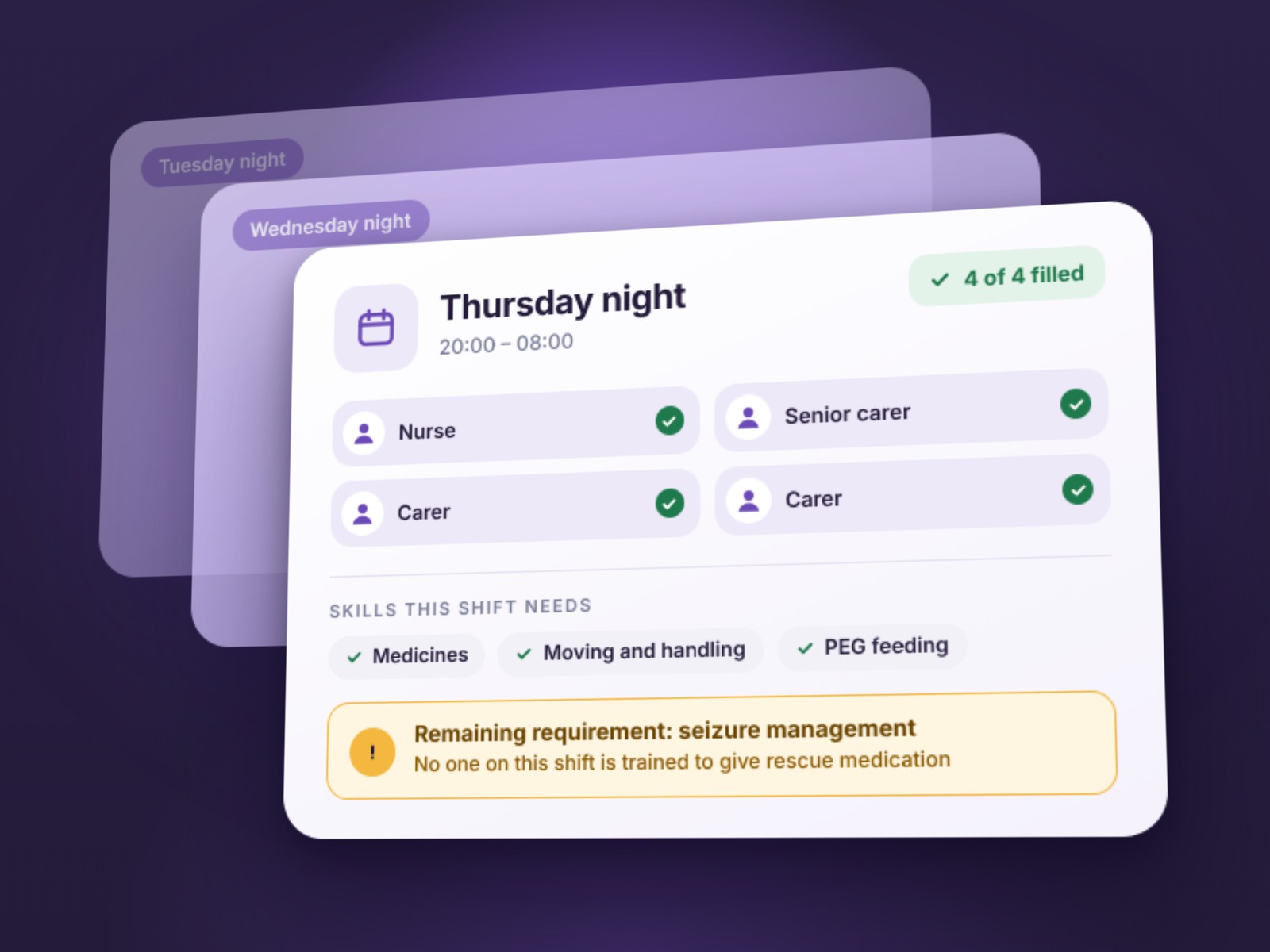
Picture a Thursday night shift. Every slot on the rota is filled, so on paper the shift is covered. But one of the people you support has epilepsy and needs rescue medication if a seizure goes on too long, and none of the staff on that night is trained to give it. Nobody would spot that from a count of heads. It only shows up if someone checks the skills on the shift against the needs of the people being cared for, and does it before the shift starts.
That is what the law already asks. Regulation 18 requires "sufficient numbers of suitably qualified, competent, skilled and experienced persons" to be deployed, and CQC's guidance says staffing levels and skill mix "must be reviewed continuously and adapted to respond to the changing needs" of the people using the service.
The report shows what good looks like too. Services rated outstanding for safety kept full oversight of training gaps and checked competency through audits, observation and supervision. One outstanding homecare service used a "digital safeguard" on its rostering system, so that before staff were allocated to someone, they had the training that person's specific needs called for.
Four questions to ask of your rota
Do you know which skills each shift needs?
Not just how many staff, but which needs the people in your care have that night: epilepsy, PEG feeding, positive behaviour support, medicines.
Where do those needs come from?
If they live in someone's head or a separate spreadsheet, they can drift away from the care plan when a person's needs change.
Can you see a gap before the shift starts?
Finding out at handover leaves you ringing round for cover.
Does the rota match who actually turned up?
CQC found rotas that did not reflect the staff on duty, which undermines every other check.
That check is how rostering works in Ameryst. The skills a shift needs come straight from people's care plans, and the rota compares them with the staff booked on, showing any gap days before the shift, while there is still time to fix it. See how it works.