
An inspector asks when a person's care plan was last reviewed, and who agreed it. In some services the answer is on screen within a minute. In others it means a hunt through a shared drive, a paper file and a spreadsheet, or waiting for the one colleague who knows where everything is kept.
CQC's ratings rest on evidence, and much of it comes from your records. With CQC about to change how it assesses services, now is a sensible time to check whether yours would hold up.
What CQC is changing
Since late 2023, CQC has assessed services against its Single Assessment Framework: the five key questions (safe, effective, caring, responsive and well-led), 34 quality statements, and six categories of evidence. Those categories are people's experience, feedback from staff and leaders, feedback from partners, observation, processes and outcomes.
That framework is now being replaced. After its Better regulation, better care consultation, CQC is moving to separate frameworks for each main sector.
| When | Milestone |
|---|---|
| December 2025 | Consultation closed |
| March 2026 | Draft frameworks published for adult social care, mental health, primary and community care, and hospitals |
| June to October 2026 | Pilots run alongside normal inspections |
| November 2026 | Final evaluation of the pilots |
| End of 2026 | CQC plans to start using the new frameworks (no date set yet) |
The drafts keep the five key questions. Key lines of enquiry replace the quality statements, rating characteristics set out what outstanding, good, requires improvement and inadequate care look like, and numerical scoring is dropped. Until CQC switches over, inspections carry on under the current framework.
What isn't changing: the law on records
Whatever the new key lines of enquiry say, the legal duty behind them stays the same. Regulation 17 requires every provider to:
"maintain securely an accurate, complete and contemporaneous record in respect of each service user"
Health and Social Care Act 2008 (Regulated Activities) Regulations 2014, Regulation 17(2)(c)
That includes the care given and the decisions taken about it. CQC's guidance spells out what this means in practice. Records should be:
- complete, legible, accurate and up to date, with entries made promptly
- clear about every decision on care and treatment, including changes to consent and the reasons for them
- available to the people who need them, inside your service and with partners
- secure, and changed only by people with the right to change them
Regulation 17 also covers governance. Providers are expected to audit their service, act on the findings and track progress against improvement plans, and the records of that work count as evidence in their own right.
Where evidence falls down
Most services keep good records. Problems tend to come from where those records live and what happens to them over time.
Information split across systems is the most common. Notes might sit in one place, the rota in another and care plans in a shared folder. Each can be accurate on its own, yet nobody can see the whole picture for one person.
Then there's history. If a care plan is saved over each time it changes, you can't show what was agreed before, who agreed it or when. An entry with no clear author or time is hard for an inspector to rely on, and just as hard for the next nurse or carer on shift.
Reporting is the other gap. When a simple question means exporting data and counting by hand, the answer often arrives after the inspector has gone. Outcomes work the same way. You may know the people you support are doing better, but showing it takes the same measure, repeated over time.
Six questions to ask of your care system
A quick way to test your current set-up is to put these questions to it.
Can you see everything about a person in one place?
Notes, care plans, assessments, bookings and the people around them, linked in one record.
Does every entry carry a name and a time?
And once a note is finished, is it locked, so nobody can quietly change it later?
Can you show a care plan's history?
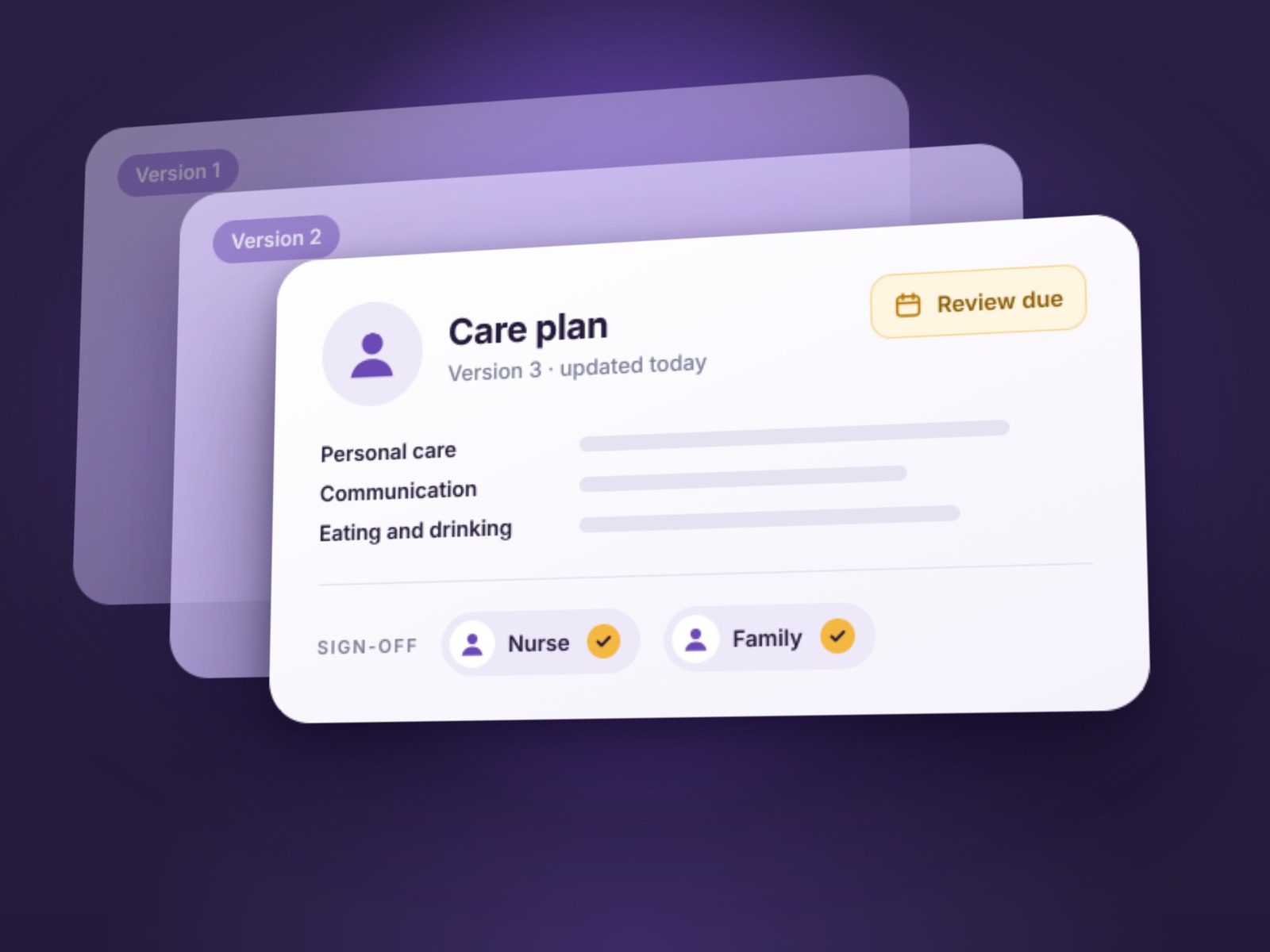
Every earlier version, who signed each one, and whether the right person gave consent.
Can you answer a question on the day?
Open the care plan, notes or record the inspector asks about there and then, rather than promising to send it next week.
Can you show outcomes over time?
Assessments repeated on the same scale, so improvement shows up in figures.
Can you show who has seen what?
Access set by role, with a log of who opened a record as well as who changed it.
How Ameryst helps you show it
Ameryst was developed inside a working care service, so the record-keeping CQC expects is part of everyday use rather than a job saved for the end of a shift.
Notes are time-stamped and signed by the person who wrote them, then locked once they're finished. Where you set it up, a senior colleague or mentor can sign them off as well. Nothing is deleted. Every edit is recorded in the audit trail, and a note that's no longer needed is archived with the reason recorded.
When a care plan changes, the previous version is archived in full along with the signatures given for it. If something was added in error, the archive can be corrected, and the audit trail shows who made the change and why. Signing rights follow capacity, parental responsibility and power of attorney, so the right person signs.
On the day, you can open the care plan, notes or record an inspector asks about there and then, and standard reports cover the questions that come up every time. Access can be limited down to individual sections of the record. The activity log shows who opened a record, and the audit trail tracks every change made to it.
If CQC's changes have you looking again at your records, book a demo and we'll show you how Ameryst answers the six questions above.